About This Article
Zoom Baby has supplied pregnancy, ovulation and fertility tests to UK customers for over 20 years. This guide explains what fertility-friendly lubricants are, why lubricant choice can matter when trying to conceive, and what the evidence says about their effect on sperm and pregnancy chances.
Published: December 2022 | Last Updated: 22 August 2026 | By: Anthony Cunningham
Fertility-friendly lubricants are designed for people who want or need to use a lubricant while trying to conceive. Unlike some conventional lubricants, they are formulated to minimise interference with sperm movement and survival.
That does not mean that using a fertility lubricant will make you pregnant. Instead, its main advantage is that it provides lubrication without some of the potential effects on sperm associated with certain standard lubricants.
Contents
- What are fertility-friendly lubricants?
- Why can ordinary lubricants be a problem?
- Can fertility lubricants help you get pregnant?
- Choosing a fertility-friendly lubricant
- Other ways to improve your chances of conceiving
- Conclusion
What Are Fertility-Friendly Lubricants?
Fertility-friendly lubricants, sometimes described as sperm-friendly lubricants, are personal lubricants specifically formulated for use when trying to conceive.
They are designed to provide comfortable lubrication while avoiding ingredients, pH levels or other characteristics that may adversely affect sperm movement or survival.
Different products use different formulations, so it is better to look at the information provided for an individual lubricant rather than assume that every fertility lubricant has exactly the same ingredients or properties.
Why Can Ordinary Lubricants Be a Problem?
Some commonly available personal lubricants have been found to reduce sperm motility or survival in laboratory studies. The American Society for Reproductive Medicine notes that a number of water-based lubricants can inhibit sperm motility in vitro, although not every lubricant has the same effect.
Importantly, laboratory findings do not necessarily mean that using a conventional lubricant prevents pregnancy. Research involving couples trying to conceive has not shown that lubricant use itself reduces the chance of conception during a menstrual cycle.
However, if you need a lubricant while trying for a baby, choosing one specifically formulated to be compatible with sperm is a straightforward precaution.
Can Fertility Lubricants Help You Get Pregnant?
A fertility-friendly lubricant should not be regarded as a fertility treatment or as a proven way of increasing your chance of becoming pregnant.
Its purpose is different. It allows couples to use a lubricant while trying to conceive without unnecessarily exposing sperm to a product known to have potentially detrimental effects on sperm function.
This can also be useful when vaginal dryness makes intercourse uncomfortable. Trying for a baby can sometimes make sex feel more planned or pressured, and appropriate lubrication may help make intercourse more comfortable.
The distinction is important: fertility-friendly lubricants are designed to be compatible with conception, rather than to cause conception.
Choosing a Fertility-Friendly Lubricant
Several fertility-friendly lubricants are available, including Pre-Seed, Conceive Plus and Babystart FertilSafe PLUS.
When choosing a product, check that it is specifically intended for use by couples trying to conceive and follow the manufacturer’s instructions. Different products vary in their formulation, application method and recommended amount.
You can see the current range of fertility lubricants available from Zoom Baby.
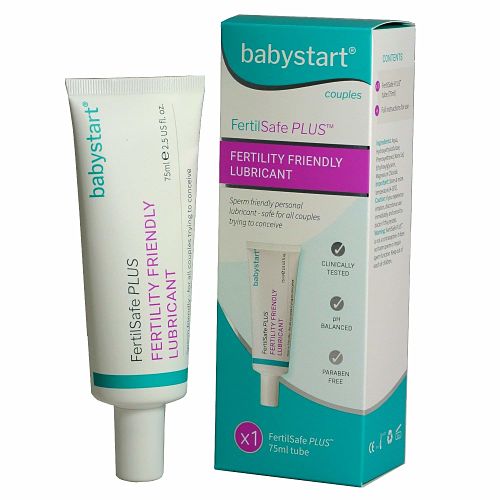
Featured Product: Babystart FertilSafe PLUS Fertility Lubricant 75ml Tube
If you prefer to use a lubricant when trying to conceive, Babystart FertilSafe PLUS is a sperm-friendly personal lubricant formulated for couples trying for a baby. It is designed to provide comfortable lubrication without harming sperm motility or viability.
Other Ways to Improve Your Chances of Conceiving
Lubricant choice is only a small part of trying for a baby. The NHS recommends having sex without contraception every 2 to 3 days. This helps ensure that sperm are present during the fertile part of the menstrual cycle without making intercourse dependent on identifying one particular day.
You are more likely to become pregnant around ovulation. Ovulation usually takes place around 14 days before the start of your next period, although the exact timing depends on the length of your menstrual cycle.
You can learn more about your fertile window using ovulation tests, although regular intercourse throughout the cycle remains important.
Other pre-pregnancy measures include eating a balanced diet, maintaining a healthy weight, avoiding smoking and taking a daily folic acid supplement before conception and during early pregnancy.
If you have been trying to conceive for a year without success, speak to your GP. You should seek advice sooner if you are aged 36 or over or have another reason to be concerned about your fertility.
Conclusion
Fertility-friendly lubricants can be a useful choice for couples who want or need lubrication while trying for a baby. Their main benefit is that they are designed to be compatible with sperm, rather than being a treatment that directly increases fertility.
If intercourse is comfortable without a lubricant, there is no need to use one simply because you are trying to conceive. If you do prefer to use lubrication, choosing a product specifically formulated for couples trying for a baby is a sensible option.
For most couples, the fundamentals remain more important: have regular sex throughout the cycle, be aware of the fertile window and seek medical advice if pregnancy is taking longer than expected.
About the Author
Anthony Cunningham, BA (Hons), MA, is a UK-based fertility testing expert and editor with over 20 years’ experience running Zoom Baby, a trusted source for accurate pregnancy, ovulation and fertility tests and testing guidance. He creates clear, evidence-based articles using NHS guidance, professional fertility resources, and conception planning best practices. Where possible, content is reviewed by fertility specialists and healthcare professionals to enhance accuracy and reliability, helping readers make informed testing decisions.