
About This Article
Zoom Baby has over 20 years’ experience providing fertility, ovulation and pregnancy testing products and guidance. This article examines research into pesticide exposure and sperm concentration, the wider evidence on declining sperm counts and the role and limitations of home male fertility testing.
Published: 15 November 2020 | Last Updated: 27 August 2026 | By: Anthony Cunningham
For decades, scientists have sought to explain an ongoing decline in sperm concentrations globally. A comprehensive analysis published in 2023 found an association between exposure to certain commonly used insecticides and lower sperm concentration.
Researchers compiled and systematically reviewed 25 previous studies looking at links between organophosphate and carbamate pesticide exposure and male fertility. These classes of insecticides are widely used in commercial agriculture and home pest control products.
Across the review, 25 studies were included, while the main meta-analysis combined data from 20 studies involving 1,774 adult men. It found that higher exposure to organophosphate and N-methyl carbamate insecticides was associated with lower sperm concentrations, although the mainly observational evidence cannot by itself prove that pesticide exposure caused the reduction.
Lead researcher Dr. Melissa Perry, Dean of the College of Public Health at George Mason University, summarised the findings: “No matter how we analysed the results, we observed a persistent association between increasing insecticide levels and decreasing sperm counts.” She expressed hope regulators would take note when making decisions about public safety and pesticide use.
Contents
- Taking Action: Practical Steps For Protection
- The Benefits Of At-Home Male Fertility Testing
- Convenience And Privacy
- Provides Valuable Insight
- Easy-To-Use And Understand
- Reliable And Accurate Technology
Taking Action: Practical Steps For Protection
You’re probably wondering what you can do right now to protect yourself. Completely avoiding pesticide exposure is not realistic, but unnecessary exposure can be reduced. If you use pesticides at work, in the garden or around the home, always follow the product instructions and use any recommended protective equipment. Wash your hands after use, avoid contact with treated areas where advised and follow the label instructions for storage, application and disposal.
Independent expert Dr. John Meeker of the University of Michigan found the analysis to be rigorous and its conclusions convincing. He agreed that the findings add to concerns about pesticide exposure and male reproductive health, while other environmental and lifestyle factors are also likely to contribute to long-term changes in sperm counts.
The biological mechanisms behind pesticides’ sperm impacts remain uncertain pending more research. But lower sperm concentrations are an established indicator of reduced male fertility. So these results raise reasonable concerns around reproductive harms from ongoing pesticide exposures for men desiring future fatherhood.
Broader research has also found a substantial decline in sperm concentration internationally. A major 2022 meta-analysis covering samples collected between 1973 and 2018 estimated a 51.6% decline in mean sperm concentration among unselected men, with the rate of decline appearing to accelerate after 2000. The reasons are likely to be complex, and the researchers called for further investigation into the causes.
Figuring out any single dominant cause for worldwide sperm count reductions has proven complicated though. Sperm themselves and factors influencing their viability are complex. Moreover, other modern health issues like rising rates of obesity likely play a role too. Still pesticide exposures can no longer be ruled out as at least a contributor to declining male fertility in light of the accumulated evidence.
While low sperm counts present fertility troubles, so do issues with sperm’s size, shape, and motility. On top of declining concentrations, these aspects of sperm health may also connect to environmental contaminants like pesticides accumulating in people over decades. So further investigation is warranted into the full impacts these exposures could exert on male reproductive capacity.
For now, the available research provides evidence of an association between higher adult exposure to organophosphate and N-methyl carbamate insecticides and lower sperm concentration. Men who use pesticides at work or at home should follow the product’s safety instructions carefully and take the recommended precautions to minimise unnecessary exposure.
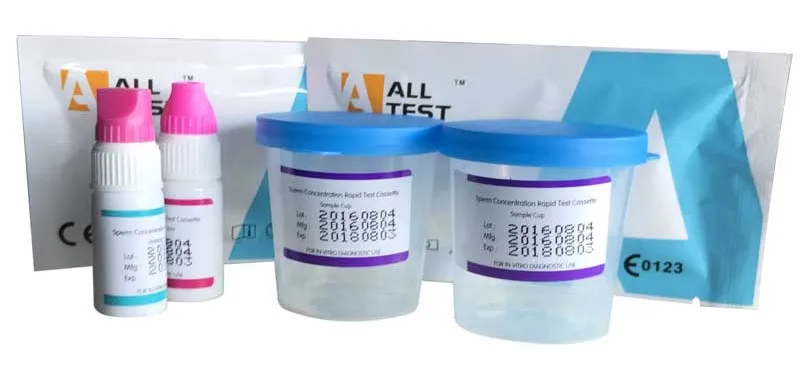
Featured Product: Male Fertility Kit / Sperm Concentration Test
The Male Fertility Kit / Sperm Concentration Test provides a private way to check whether sperm concentration is above or below the device’s 15 million sperm per mL cut-off. It can provide useful preliminary information, but it does not assess every aspect of sperm quality or replace a laboratory semen analysis where fertility problems are suspected.
The Benefits Of At-Home Male Fertility Testing
Knowing your fertility status can bring peace of mind for couples trying to conceive. The Zoom Baby Male Fertility Test Kit allows men to easily and privately check their sperm concentration from the comfort of home.
The test takes just 5 minutes to complete and provides a result indicating whether a man’s sperm concentration is above or below 15 million sperm per mL. This can provide useful preliminary information, but the result does not by itself confirm whether a man is fertile.
Convenience And Privacy
Unlike traditional semen analysis testing, the Zoom Baby kit spares men the inconvenience of scheduling appointments and visiting clinics. The privacy of home testing also avoids any embarrassment or discomfort.
The Zoom Baby kit ensures complete discretion in packaging and purchase. Taking control over one’s fertility in the privacy of home can be empowering.
Provides Valuable Insight
By measuring sperm concentration, the test can provide useful preliminary information for couples. A result above the test’s 15 million sperm per mL cut-off can be reassuring, but it does not prove that a man is fertile because sperm movement, morphology and other factors can also affect fertility.
For lower concentrations, the test allows men to proactively address potential issues before trying to conceive. Although not proof of infertility, a result below the threshold is a reason to seek reproductive health advice.
Easy-To-Use And Understand
The Zoom Baby kit includes simple instructions for hassle-free home testing. Unlike complex medical reports, results are easy to interpret: simply positive or negative.
There’s no confusion over what to do next. A result above the test threshold can provide useful preliminary information, while a result below the threshold is a reason to speak to your GP about whether further fertility assessment is appropriate.
Reliable And Accurate Technology
The Zoom Baby Male Fertility Test uses SP10 protein detection technology to evaluate sperm concentration against the device’s 15 million sperm per mL cut-off.
The result can provide useful initial information about sperm concentration, but a home test does not replace a full laboratory semen analysis or provide a definitive assessment of male fertility.
Knowing your fertility status can be empowering. The Zoom Baby Male Fertility Test Kit offers an easy, private way for men to gain initial information about their reproductive health.
About the Author
Anthony Cunningham, BA (Hons), MA, is a UK-based fertility testing expert and editor with over 20 years’ experience running Zoom Baby, a trusted source for accurate pregnancy, ovulation and fertility tests and testing guidance. He creates clear, evidence-based articles using NHS guidance, professional fertility resources, and conception planning best practices. Where possible, content is reviewed by fertility specialists and healthcare professionals to enhance accuracy and reliability, helping readers make informed testing decisions.