About This Article
Zoom Baby has over 20 years’ experience helping people understand pregnancy, ovulation and fertility testing. This article looks at what Pre-Seed fertility lubricant is, what users report about it, how it should be used, and what the evidence can and cannot tell us about its role when trying to conceive.
Published: 3 July 2024 | Last Updated: 17 August 2026 | By: Anthony Cunningham
If you’re trying to get pregnant, you may have heard of Pre-Seed and wondered whether it can help. Here we look at what Pre-Seed is, how it is used and what the evidence says about fertility-friendly lubricants.
Pre-Seed is a fertility-friendly lubricant designed for couples who are trying to conceive. Its formulation is intended to provide lubrication without adversely affecting sperm in the way that some conventional lubricants can in laboratory testing.
It is important to keep its role in perspective. Pre-Seed is a lubricant rather than a fertility treatment, and there is no established evidence that using it increases pregnancy rates. For couples who need additional lubrication while trying to conceive, however, choosing a sperm-friendly lubricant can be a sensible option.
Pregnancy journeys vary considerably. NHS guidance recommends speaking to a GP if you have not conceived after a year of regular unprotected sex. Women aged 36 or over, and anyone who already has reason to be concerned about their fertility, should seek advice sooner.
Contents
- User Experiences with Pre-Seed
- Using Pre-Seed with Other Fertility Methods
- Using Pre-Seed Correctly
- Patience and Perseverance
- Peace of Mind
- Considerations and Side Effects
- What the Evidence Says
- Conclusion
User Experiences with Pre-Seed
Online reviews contain many positive experiences from couples who have used Pre-Seed while trying to conceive. These accounts can be useful for understanding how people find the product in practice, but they should not be taken as evidence that Pre-Seed caused a pregnancy.
Some reviewers report becoming pregnant during the first few cycles in which they used Pre-Seed, including people who had already been trying to conceive for several months. Others say that they appreciated being able to use additional lubrication without worrying that they might be choosing a product that was unsuitable when trying for a baby.
However, conception depends on many factors. People leaving positive reviews may also have been tracking ovulation, timing intercourse or making other changes at the same time, so it is not possible to know what role, if any, the lubricant played in an individual pregnancy.
Using Pre-Seed with Other Fertility Methods
Many people who report using Pre-Seed also mention other approaches, particularly tracking ovulation and timing intercourse around the fertile window. This makes it difficult to attribute a successful pregnancy to any one part of their routine.
If you are trying to conceive naturally, identifying the fertile part of the menstrual cycle can help with timing intercourse. Ovulation tests can be used to detect the rise in luteinising hormone that occurs shortly before ovulation.
Pre-Seed should therefore be viewed as an option for lubrication when needed, rather than something that replaces ovulation tracking, appropriate timing or medical advice where fertility problems are suspected.
Using Pre-Seed Correctly
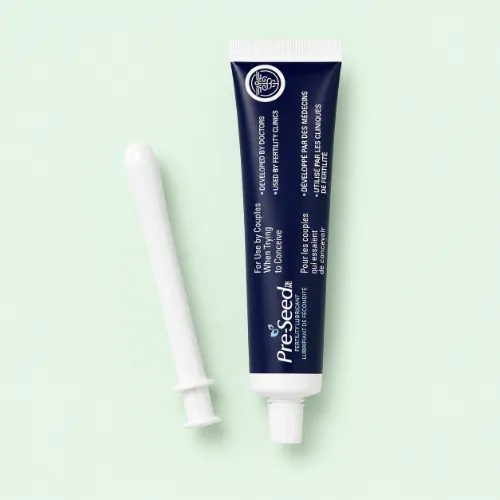
Follow the instructions supplied with the product rather than relying on quantities suggested in individual online reviews. Pre-Seed can be applied internally using the supplied single-use applicators or externally when additional lubrication is needed.
The current Pre-Seed pack available from Zoom Baby contains a 40g tube together with single-use applicators. Use only the amount needed for comfortable intercourse and follow the directions supplied with the product.

Featured Product: Pre-Seed Fertility Lubricant
Pre-Seed Fertility Lubricant is designed for couples who need additional lubrication while trying to conceive. Its formulation is designed to be compatible with sperm, making it an alternative to conventional lubricants that may adversely affect sperm in laboratory testing.
Patience and Perseverance
Some reviewers associate Pre-Seed with the cycle in which they eventually became pregnant after trying for many months. That can understandably make the product feel important to their personal conception story, but it does not establish that the lubricant was responsible for the pregnancy.
Even when intercourse is well timed, conception does not necessarily happen immediately. It can take time, and individual experiences with fertility products vary considerably.
If you have been trying to conceive for a year without success, speak to your GP. Women aged 36 or over, or anyone who knows of a possible fertility problem, should seek advice sooner.
Peace of Mind
One reason some couples choose a fertility-friendly lubricant is peace of mind. Laboratory research has shown that some conventional lubricants can adversely affect sperm movement or other sperm characteristics, although research in couples trying to conceive has not shown that lubricant use itself necessarily reduces the chance of pregnancy in a cycle.
For people who experience vaginal dryness or simply prefer to use a lubricant during sex, choosing a product specifically designed to be sperm-friendly may therefore feel like a more appropriate option while trying to conceive.
Considerations and Side Effects
As with any lubricant, personal preferences vary. Some users describe Pre-Seed as very slippery or find that using too much can feel messy. Starting with the amount recommended in the product instructions and adjusting within those directions may make it more comfortable to use.
Stop using the product if you experience irritation or discomfort. If symptoms persist or you are concerned about vaginal irritation, speak to a pharmacist, GP or other healthcare professional.
What the Evidence Says
It is useful to distinguish between being sperm-friendly and being proven to increase fertility. These are not the same thing.
Some lubricants have been shown to affect sperm adversely in laboratory studies. Fertility-friendly lubricants are formulated to avoid this problem as far as possible. However, this does not mean that a lubricant makes conception happen or treats an underlying fertility problem.
The American Society for Reproductive Medicine notes that while some lubricants can negatively affect sperm parameters in laboratory testing, studies of couples trying to conceive have not shown lubricant use to reduce cycle fecundability compared with not using lubricant.
In practical terms, Pre-Seed is best understood as a lubricant designed to be suitable for use while trying to conceive. It should not be presented as a treatment for infertility or as a product proven to increase pregnancy rates.
Conclusion
Many couples have positive things to say about using Pre-Seed, particularly those who want additional lubrication while trying for a baby. Some users also report becoming pregnant during cycles in which they used it, but individual testimonials cannot show that Pre-Seed caused those pregnancies.
The main benefit of a product such as Pre-Seed is that it is specifically designed to be compatible with sperm. This makes it a reasonable option for couples who want or need a lubricant during their fertile window without relying on a conventional lubricant that may be less suitable in laboratory testing.
If you are having difficulty conceiving, do not rely on a lubricant to solve an underlying fertility problem. NHS guidance recommends speaking to a GP after a year of regular unprotected sex without conception, or sooner if the woman is aged 36 or over or there is another reason for concern.
You can find out more about Pre-Seed Fertility Lubricant on the Zoom Baby website.
About the Author
Anthony Cunningham, BA (Hons), MA, is a UK-based fertility testing expert and editor with over 20 years’ experience running Zoom Baby, a trusted source for accurate pregnancy, ovulation and fertility tests and testing guidance. He creates clear, evidence-based articles using NHS guidance, professional fertility resources, and conception planning best practices. Where possible, content is reviewed by fertility specialists and healthcare professionals to enhance accuracy and reliability, helping readers make informed testing decisions.