About This Article
Zoom Baby has over 20 years’ experience supplying pregnancy, ovulation and fertility tests and providing testing guidance. This article compares Conceive Plus, Pre-Seed and FertilSafe PLUS, explains what sperm-friendly lubricants can and cannot do, and outlines when to seek fertility advice.
Originally Published: November 2018 | Last Updated: 11 October 2026 | By: Anthony Cunningham, Fertility Testing Expert & Editor
If you need a lubricant when trying for a baby, a product specifically designed to be sperm-friendly is a reasonable choice. Its purpose is to make sex more comfortable while minimising interference with sperm. You do not need to use a fertility lubricant simply because you are trying to conceive.
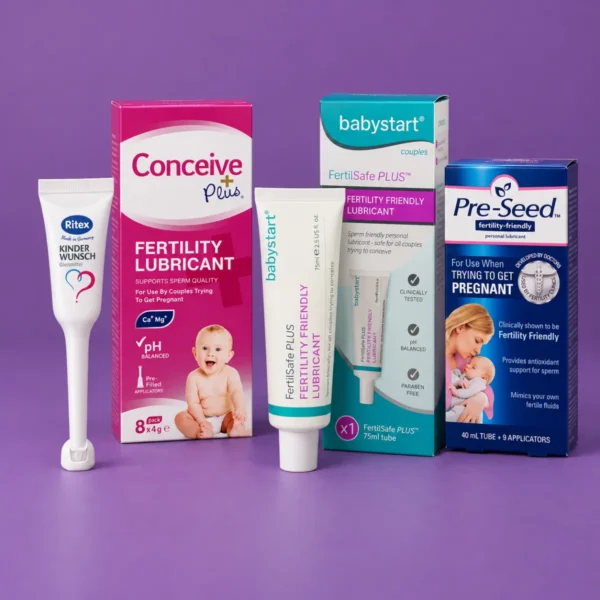
Conceive Plus, Pre-Seed and FertilSafe PLUS offer different pack sizes and application options. The best choice depends on your comfort, whether you prefer a tube or applicators, and the instructions supplied with the product.
Contents
- Do Fertility Lubricants Improve Your Chances?
- Conceive Plus
- Pre-Seed (aka PreSeed)
- FertilSafe PLUS
- How to Choose and Use a Fertility Lubricant
- When to Seek Fertility Advice
Do Fertility Lubricants Improve Your Chances?
Some everyday lubricants reduce sperm movement or survival in laboratory tests. However, laboratory findings do not automatically tell us what happens to pregnancy rates. The American Society for Reproductive Medicine’s guidance notes that studies of couples trying to conceive found no reduction in the chance of conception per cycle associated with lubricant use.
It is therefore too strong to say that ordinary lubricants prevent pregnancy, or that sperm-friendly lubricants make you pregnant faster. Sperm compatibility is different from proof of improved pregnancy or live birth rates. Customer pregnancy stories cannot establish that a particular lubricant caused conception.
Likewise, “non-spermicidal” means a product does not contain a spermicide; it does not establish that the formulation has been tested for sperm compatibility.
Conceive Plus
Conceive Plus is a sperm-friendly lubricant made by SASMAR. The manufacturer describes its formulation as pH-balanced and isotonic, and lists calcium and magnesium among its ingredients. These formulation details should not be treated as proof that it increases pregnancy rates.
Zoom Baby currently lists a 30ml tube, a 75ml tube and eight 4g pre-filled applicators. A tube allows you to dispense lubricant as needed; pre-filled applicators offer individual doses. An eight-applicator pack does not necessarily represent a month’s supply.

Featured Product: Conceive Plus Fertility Lubricant, 75ml Tube
The Conceive Plus 75ml tube is an option if you prefer a multi-use tube to pre-filled applicators. Check the product page for current availability and follow the instructions in your pack.
Pre-Seed (aka PreSeed)
Pre-Seed is a fertility-friendly lubricant intended to provide moisture during intimacy. The Pre-Seed pack listed by Zoom Baby contains a 40g multi-use tube and nine single-use applicators.
The applicators allow internal application according to the pack instructions. Each is intended for one use and should then be discarded. Choose Pre-Seed if this application format suits you, rather than assuming it is more likely than another sperm-friendly lubricant to result in pregnancy.
FertilSafe PLUS
FertilSafe PLUS is made by Babystart. The manufacturer describes it as sperm-friendly, pH-balanced, and free from parabens and glycol. Babystart reports testing by a UK andrology clinic within the NHS to assess sperm compatibility. This is not the same as NHS endorsement or proof that the product improves pregnancy rates.
Zoom Baby lists a FertilSafe PLUS 75ml tube. A separate multi pack is listed with a 75ml tube, two reusable applicators and two pre-filled 5ml applicators, but was marked out of stock when checked on 11 October 2026. Check the listing for any change.
How to Choose and Use a Fertility Lubricant
- Choose the format that suits you: consider whether you want a multi-use tube, applicators you fill yourself, or pre-filled applicators.
- Read the current pack instructions: application methods, amounts and timing differ between products. Do not assume one brand’s directions apply to another.
- Check the expiry date and packaging: do not use expired products or applicators with a damaged seal. Discard single-use applicators after use; clean reusable ones only as directed.
- Check the ingredients: choose with any known sensitivities in mind. Stop using a product if it causes irritation and seek advice if symptoms persist.
A lubricant is not a treatment for infertility. If you are having fertility treatment or providing a semen sample, ask your clinic which products, if any, are suitable.
When to Seek Fertility Advice
The NHS advice on trying to get pregnant supports regular sex without contraception every two to three days. Preparing for pregnancy also includes stopping smoking, avoiding alcohol and discussing any medicines or health conditions with your GP.
According to NHS infertility guidance, see a GP if you have not conceived after a year of trying. Women aged 36 or over, and anyone who already knows they may have fertility problems, should seek advice sooner.
Do not wait a year if you have concerns such as irregular or absent periods, known endometriosis, an existing sperm problem, or difficulty having sex. Discuss these with your GP rather than relying on a different lubricant to resolve them.
The best fertility lubricant for you is one that provides comfortable lubrication, has been designed for use when trying to conceive, and suits your preferred method of application. There is no established pregnancy-rate winner among the three products discussed here.
Sources and Product Information
- ASRM: Optimizing Natural Fertility, Committee Opinion (2022)
- NHS: Trying to Get Pregnant
- NHS: Infertility
- Conceive Plus: Manufacturer’s 75ml Product Information
- Babystart: FertilSafe PLUS Product Information
- Zoom Baby: Current Fertility Lubricant Listings
About the Author
Anthony Cunningham, BA (Hons), MA, is a UK-based fertility testing expert and editor with over 20 years’ experience running Zoom Baby, a trusted source for accurate pregnancy, ovulation and fertility tests and testing guidance. He creates clear, evidence-based articles using NHS guidance, professional fertility resources, and conception planning best practices. Where possible, content is reviewed by fertility specialists and healthcare professionals to enhance accuracy and reliability, helping readers make informed testing decisions.
Medical Disclaimer
This article is for general information only and is not a substitute for professional medical advice, diagnosis or treatment. If you have concerns about your health or symptoms, speak to your GP or another qualified healthcare professional. In an emergency, seek urgent medical help.